I thought this was well done, and slightly fascinating. I love simplicity :) Also, having lived on an Apple Orchard, this lil vid holds a special place in my heart. Enjoy :)
The Seed from Johnny Kelly on Vimeo.
Tuesday, March 31, 2009

Monday, March 23, 2009
A Type of Fire
I read today with sadness that Nicholas Hughes, son of Sylvia Plath and Ted Hughes, had committed suicide. What he must have gone through. You can read the story in the NYTimes or on MSN. I like the MSN article better because it speaks about Mr. Hughes, not just his parents. Anyhow, any suicide is a tragedy, no matter who it is. It reminded me of this poem by Taylor Mali :
Edit: Thanks to JH for posting this article My Friend Nick
Google Tools
Search Google Images by Color
*edit* Google has now added a little box on their Image Search in order to search by color! lol so much for my little hack secret!!! :)

Also:
Search Google Images by Dimension
This is really great when you're looking for wallpaper of high quality images.
*edit* Google has now added a little box on their Image Search in order to search by color! lol so much for my little hack secret!!! :)

Also:
Search Google Images by Dimension
This is really great when you're looking for wallpaper of high quality images.
Saturday, March 21, 2009
Color
Here are two videos from Sony Bravia... The first I love the song, and the video had me hunched over like a five year old, smiling ear to ear. Sheer Joy :) The second is great in its own right, I love the inside shots, and always the red :) Color. John Ruskin said "The purest and most thoughtful minds are those which love color the most" Sony must have some children working for them :) It reminds me of a few Chesterton excerpts ...
"Rich colours actually look more luminous on a grey day, because they are seen against a dark background, and seem to be burning with a lustre of their own. Against a dim sky all flowers look like fireworks. There is something strange about them at once vivid and secret, like flowers traced in fire in the grim garden of a witch. A bright blue sky is necessarily the high light in the picture, and its brightness kills all the bright blue flowers. But on a grey day the larkspur looks like fallen heaven; the red daisies are really the lost-red eyes of day, and the sun-flower is the vice-regent of the sun. Lastly, there is this value about the colour that men call colourless that it suggests in some way the mixed and troubled average of existence, especially in its quality of strife and expectation and promise. Grey is a colour that always seems on the eve of changing to some other colour; of brightening into blue, or blanching into white or breaking into green or gold. So we may be perpetually reminded of the indefinite hope that is in doubt itself; and when there is grey weather on our hills or grey hair on our heads perhaps they may still remind us of the morning." (From "Daily News")
"I do not know if other people are made like me in this matter; but to me it is always dreary weather, what may be called useless weather, that slings into life a sense of action and romance. On bright blue days I do not want anything to happen; the world is complete and beautiful, a thing for contemplation. I no more ask for adventures under that turquoise dome than I ask for
adventures in church. But when the background of man's life is a grey background, then, in the name of man's sacred supremacy,I desire to paint on it in fire and gore." (From "Tremendous Trifles")
On a side note, you can watch the Making Of in this video, which leads me to say how much I love advertising -- you know, its about the product, a very practical matter, and its also about humanity. The really good advertising is the one that can connect on a human level. I suppose if I had gone into Graphic Design like I originally intended, I might have ended up in advertising -- technical and creative, good stuff :)
"Rich colours actually look more luminous on a grey day, because they are seen against a dark background, and seem to be burning with a lustre of their own. Against a dim sky all flowers look like fireworks. There is something strange about them at once vivid and secret, like flowers traced in fire in the grim garden of a witch. A bright blue sky is necessarily the high light in the picture, and its brightness kills all the bright blue flowers. But on a grey day the larkspur looks like fallen heaven; the red daisies are really the lost-red eyes of day, and the sun-flower is the vice-regent of the sun. Lastly, there is this value about the colour that men call colourless that it suggests in some way the mixed and troubled average of existence, especially in its quality of strife and expectation and promise. Grey is a colour that always seems on the eve of changing to some other colour; of brightening into blue, or blanching into white or breaking into green or gold. So we may be perpetually reminded of the indefinite hope that is in doubt itself; and when there is grey weather on our hills or grey hair on our heads perhaps they may still remind us of the morning." (From "Daily News")
"I do not know if other people are made like me in this matter; but to me it is always dreary weather, what may be called useless weather, that slings into life a sense of action and romance. On bright blue days I do not want anything to happen; the world is complete and beautiful, a thing for contemplation. I no more ask for adventures under that turquoise dome than I ask for
adventures in church. But when the background of man's life is a grey background, then, in the name of man's sacred supremacy,I desire to paint on it in fire and gore." (From "Tremendous Trifles")
On a side note, you can watch the Making Of in this video, which leads me to say how much I love advertising -- you know, its about the product, a very practical matter, and its also about humanity. The really good advertising is the one that can connect on a human level. I suppose if I had gone into Graphic Design like I originally intended, I might have ended up in advertising -- technical and creative, good stuff :)
Friday, March 20, 2009

Monday, March 2, 2009
The Life and Opinions of Moby Dick, Whale, Mon.
The strangest thing happened today. Well, ok, so it wasn't that strange, but I just love when this happens, and it fascinates me every time. Maybe I can turn it into a research paper... Anyhow, so there I was checking Recently Banned Literature for anything new, and generally if I have a bit of time Ill pick a blog link at random and check it out. Tristram Shandy caught my eye, and I moseyed on over there to check it out. (Btw, did you know that "mosey" either means to stray leisurely or to leave quickly... love words like that, especially since in this case, being the internet and all, it works perfectly both ways!  Anyway, back to the happening...) So, I read a bit, skip around, not really familiar with this work, but I know Defoe so I have a general idea of time frame and all that, checked out William's poem, dusted off a place for it in my mental library-- trying to pseudo familiarize myself with the work. After all if it's "most hated", I'm bound to run across it at some point. So you're probably wondering what is so awesome about this -- well, nothing yet because I realized mid-mosey that I have a paper on Melville due soon and I should probably be thinking about it. So off I go (no wonder I never get anything done...) So off I go to Melville's Marginalia, which my prof. told us about the other day in class. I'm thinking about doing my Moby Dick paper on Moby Dick and Pop Culture (don't ask, I really have no idea yet, except the little nugget of knowledge that Starbucks company name comes from Moby Dick...I'm nervous about that getting me ten or so pages though). Anyway, this Marginalia is awesome! Basically it's a catalogue of books borrowed and owned by Melville, and his inscriptions/marginalia. So obviously I can't search current pop culture for marginalia within Moby Dick as that would be backwards and wouldn't garner any results. So randomly I just type in "music" into the keyword search.
 Wouldn't hurt to see what Melville knows about music, plus it could always make a nice paper topic if I happened to find any music connections in Moby Dick. (Don't worry, I'm almost to the awesome part...) So I'm reading through the works that Melville owned or borrowed with music in the title or something like that. Most of them are books his father-in-law borrowed while Melville was visiting --hmmm, I wonder what Melville's father-in-law was so interested in music for. So I quickly scroll to the bottom, because by this time I'm remembering that I have a midterm History exam this afternoon, and I should probably go study. There at the bottom of the page what do you think I find?! Sterne, Laurence, 1713-1768 "The Life and Opinions of Tristram Shandy, Gent."
The very last entry. Weird! I mean of course it makes perfect sense that Melville would have read/owned this book since it was pretty popular. But really, how random that I run across it today and while searching a keyword like music. Now how cool (and anticlimactic) is that!!!! :)
 Anyway, back to the happening...) So, I read a bit, skip around, not really familiar with this work, but I know Defoe so I have a general idea of time frame and all that, checked out William's poem, dusted off a place for it in my mental library-- trying to pseudo familiarize myself with the work. After all if it's "most hated", I'm bound to run across it at some point. So you're probably wondering what is so awesome about this -- well, nothing yet because I realized mid-mosey that I have a paper on Melville due soon and I should probably be thinking about it. So off I go (no wonder I never get anything done...) So off I go to Melville's Marginalia, which my prof. told us about the other day in class. I'm thinking about doing my Moby Dick paper on Moby Dick and Pop Culture (don't ask, I really have no idea yet, except the little nugget of knowledge that Starbucks company name comes from Moby Dick...I'm nervous about that getting me ten or so pages though). Anyway, this Marginalia is awesome! Basically it's a catalogue of books borrowed and owned by Melville, and his inscriptions/marginalia. So obviously I can't search current pop culture for marginalia within Moby Dick as that would be backwards and wouldn't garner any results. So randomly I just type in "music" into the keyword search.
 Wouldn't hurt to see what Melville knows about music, plus it could always make a nice paper topic if I happened to find any music connections in Moby Dick. (Don't worry, I'm almost to the awesome part...) So I'm reading through the works that Melville owned or borrowed with music in the title or something like that. Most of them are books his father-in-law borrowed while Melville was visiting --hmmm, I wonder what Melville's father-in-law was so interested in music for. So I quickly scroll to the bottom, because by this time I'm remembering that I have a midterm History exam this afternoon, and I should probably go study. There at the bottom of the page what do you think I find?! Sterne, Laurence, 1713-1768 "The Life and Opinions of Tristram Shandy, Gent."
 The very last entry. Weird! I mean of course it makes perfect sense that Melville would have read/owned this book since it was pretty popular. But really, how random that I run across it today and while searching a keyword like music. Now how cool (and anticlimactic) is that!!!! :)
Friday, February 20, 2009
craigslist and a random find
Ok, now how cool is this? Craigslist is great when you need to find things -- whether you need them cheap, or fast, or like the keep money in the area,  or like to barter, or are looking for something unusual, or free ...you name it :) I really like Craigslist, but I'm not gonna lie, I find their search tools inadequate at best, annoying to say the least and really, just not aestetically pleasing. Well today I ran across the CraigsList Reader over at Lifehacker.
Simple program, with a pretty nice interface that makes Craigslist more efficient and better looking. And of course, its free! I love it :D Of course, I havent tried it out yet, so we'll see :)
Also this has nothing to do with the above, but i ran across this weird yet strangely intriguing website today : ManBabies... That is weird.
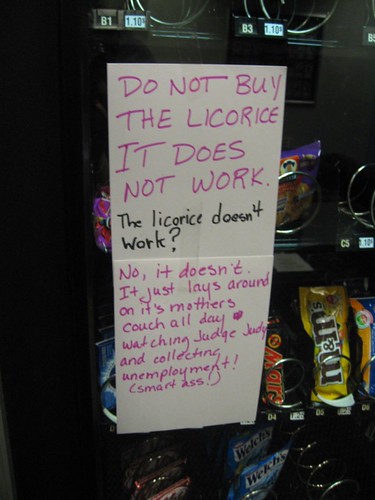
And finally, I love Passive-Agressive Notes and this one on the Vending Machine made me kill myself laughing today:
Venting Machine :
Also, this one is genius: Broken Glass
 or like to barter, or are looking for something unusual, or free ...you name it :) I really like Craigslist, but I'm not gonna lie, I find their search tools inadequate at best, annoying to say the least and really, just not aestetically pleasing. Well today I ran across the CraigsList Reader over at Lifehacker.
Simple program, with a pretty nice interface that makes Craigslist more efficient and better looking. And of course, its free! I love it :D Of course, I havent tried it out yet, so we'll see :)
Also this has nothing to do with the above, but i ran across this weird yet strangely intriguing website today : ManBabies... That is weird.
And finally, I love Passive-Agressive Notes and this one on the Vending Machine made me kill myself laughing today:
Venting Machine :
Also, this one is genius: Broken Glass
Monday, February 16, 2009
Monday, February 9, 2009
V for villian

Dr. Faustus - Chistopher Marlowe...
So I'm reading this play for Renaissance Lit. I studied it already in tenth grade, and its funny to use my old book because I have comments in the margin such as one in a passage about waxen wings that very eruditely states "like the greek guy, Icarius [sic]", which I don't even know why I wrote that, because there is a note explaining that it is in fact referring to Icarus... maybe those were the days when I was resistant to foot notes. Who knows! Anyhow, my professor is driving me crazy because she is trying to force me to find some kind of subversive meaning to the play. Now, don't get me wrong, I love subversiveness and will be the first one to jump on it, and perhaps there is an element of it to be found in Christopher Marlowe. However, I think there is something more important going on here. This is a renaissance text, and supposedly a commentary on humanist thinking. R.M. Dawkins is famously quoted as saying that Dr.F is the story of a Renaissance man who payed the medieval price for being one. Sure this is a completely orthodox reading, but I think one cannot throw it out completely, even if you think there is some kind of subversiveness going on here.
So Faustus is basically after knowledge, and sells his soul to get it. Fast forward 24 yrs and Dr. F gets dragged off to hell. Poor S.O.B. that he is. But what if Faustus' downfall is not so much his yearning for knowledge as it is his intellectual dishonesty? What if Marlowe's play is not making a hero out of Faustus as the
 quintessential Renaissance man, but rather condemning him for not being a good enough Renaissance man? Herein lies the subversiveness as far as I can tell. I don't think that Marlowe is reduced to either writing an medieval end for Faust in order to hide his subversive ideas regarding knowledge and heroism, nor do I think that Marlowe's purpose is to merely tell the story of the Renaissance man who pays the medieval price. I like to give Marlowe more credit than that. I mean come on, the man is rumored to have been a spy among other things and the English father of blank verse; gotta give him extra credit, right? Well, I do anyhow.
So you might ask what else is there then for Marlowe to be doing here. Well, let me compare it to Utopia, by St. Thomas More, another Renaissance man. Now Utopia is one of those books that people read and think its some kind of early socialist manifesto or something. There are some, however, myself included, who believe it to be rather a picture of a dystopia. A place where humanist and renaissance thinking, taken to its logical and full extent can only end in an idealized place that discounts human frailty, human individuality and essentially human nature. It is the ideal of Aristotle -- if a man but know the good then he will choose the good. Herein lies the Humanist downfall -- intellectual dishonesty. If More's contemporaries take their theories to their inevitable end, they cannot help but fall into the pitfalls of Utopia, no matter how good it sounds on paper. I think the same thing is going on in Marlowe's Dr. Faustus.
Here we have Faustus, a learned man, and more, the most learned, and yet he lies to himself. He possesses all the knowledge worth possessing (the bounded knowledge of the classical texts was to the Renaissance man, the foundation for all other knowledge, scientific or otherwise), and yet he convinces himself that its not enough and that there is more... So again we have a renaissance man who is being intellectually dishonest. By placing knowledge and the pursuit of knowledge above wisdom, the renaissance man lies to himself. If Faust truly knows all there is to know, and thus, the good, should he not then be able to choose the good and to know that he possesses all the knowledge worth knowing, the foundation of all other knowledge?
Truth be told, I'm supposed to be writing a paper about this at the moment. So I suppose I ought to go do that. Boo.
Subscribe to:
Posts (Atom)